A map-focused MECCHA CHAMELEON guide covering officially mentioned maps, community-sourced base map names, Workshop maps, and what players should verify before relying on map tips.
Last checked: 2026-07-17 Important: This page separates official update facts from community-sourced map knowledge. Do not treat community color values as official patch data.
MECCHA CHAMELEON maps matter because the game is not just about finding a hiding spot. Each map changes the paint problem: wallpaper, brick, concrete, carpet, metal, water, candy colors, and dark corners all require different color and material decisions.
Do not enter a new map asking for one magic hiding spot. Enter it asking: where are the patterned surfaces, dark clutter, rough materials, and seeker sightlines?
Officially observed map/update facts
Steam News confirms these map-related items:
- Egypt was added as a new official map in update2.7.0.
- HIKAKIN Museum was added as a collaboration map in update2.6.0, with collaboration-exclusive gimmicks.
- Penguin Hotel received random elements in update2.7.0.
- Osaka was reworked in update2.5.0.
- An out-of-bounds issue on the Osaka map was fixed in fix2.5.1.
- Hide-and-Seek Mansion received randomization for furniture and other elements in update2.2.0.
- Sewer received minor random elements in fix2.2.1.
- Random-map lottery toggles were added in update2.7.0, and collaboration maps are OFF by default.
These facts are strong enough to write about as official update history.
Community-sourced base map names
A Steam community color-code guide lists seven base maps. Treat these names as community-sourced until confirmed in-game or by official docs:
Confidence labels
Separate official patch facts from community map naming
Each base map now has a dedicated briefing with its full measured color table, surface analysis, and Hider/Seeker approach:
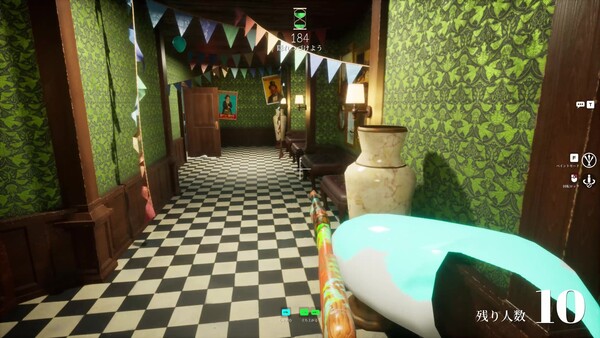
- Hide-and-Seek Mansion — maximum surface variety, randomized furniture
- Sewer — the darkest palette; brightness and gloss control
- Backrooms — monochrome yellow; silhouette is everything
- Indoor Country — lit/shade pairs and plywood standee logic
- Penguin Hotel — the pattern map; random elements added in update2.7.0
- Egypt — new official map added in update2.7.0; surface scouting pending
- HIKAKIN Museum — collaboration map added in update2.6.0; gimmick-focused scouting pending
- Sugar Land — saturation your eyes will get wrong
- Osaka — the reworked urban map; neutrals vs signage
These names are useful for search and player discussion. For actual play, treat them as a checklist of surface problems: Mansion means wallpaper/furniture; Sewer means dark pipes/brick; Sugar Land means saturated colors; Osaka means signage/asphalt.
How to think about map surfaces
Instead of memorizing “best spots,” learn what each surface type demands:
Official Steam screenshot reference
Each map type changes what “good paint” means
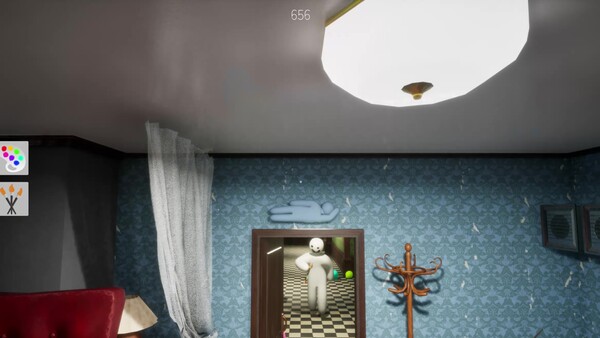
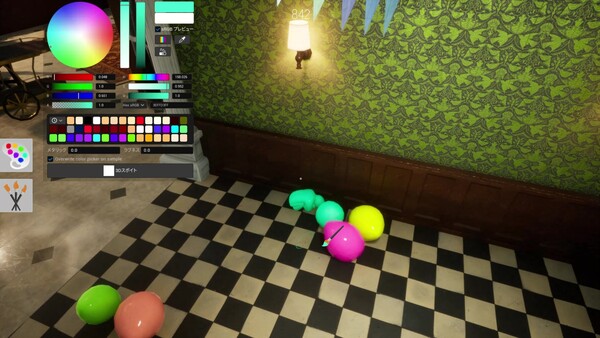
Wallpaper and patterned walls
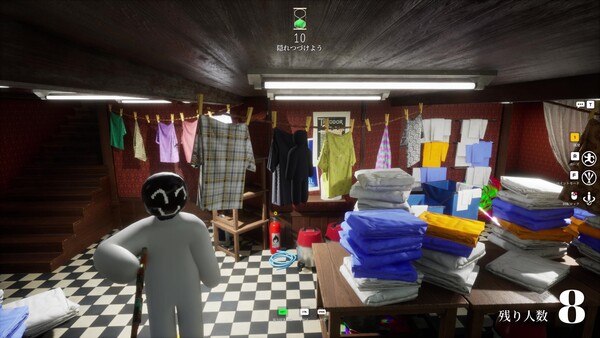
Patterned walls can hide outlines if your body is posed along the pattern. The danger is silhouette: a wrong shoulder or head shape can break the repeating design.
Brick, stone, and concrete
These surfaces often need rougher material settings. A glossy body on brick may stand out even if the RGB value is close.
Dark corners and pipes
Dark areas can hide errors, but pure black paint can also look suspicious if the corner is actually dark gray, brown, or green. Community material guides recommend checking brightness and roughness, not only hue.
Glossy or metallic spaces
Metallic and polished areas punish wrong roughness. Seekers may notice reflection mismatch before color mismatch.
Bright colorful maps
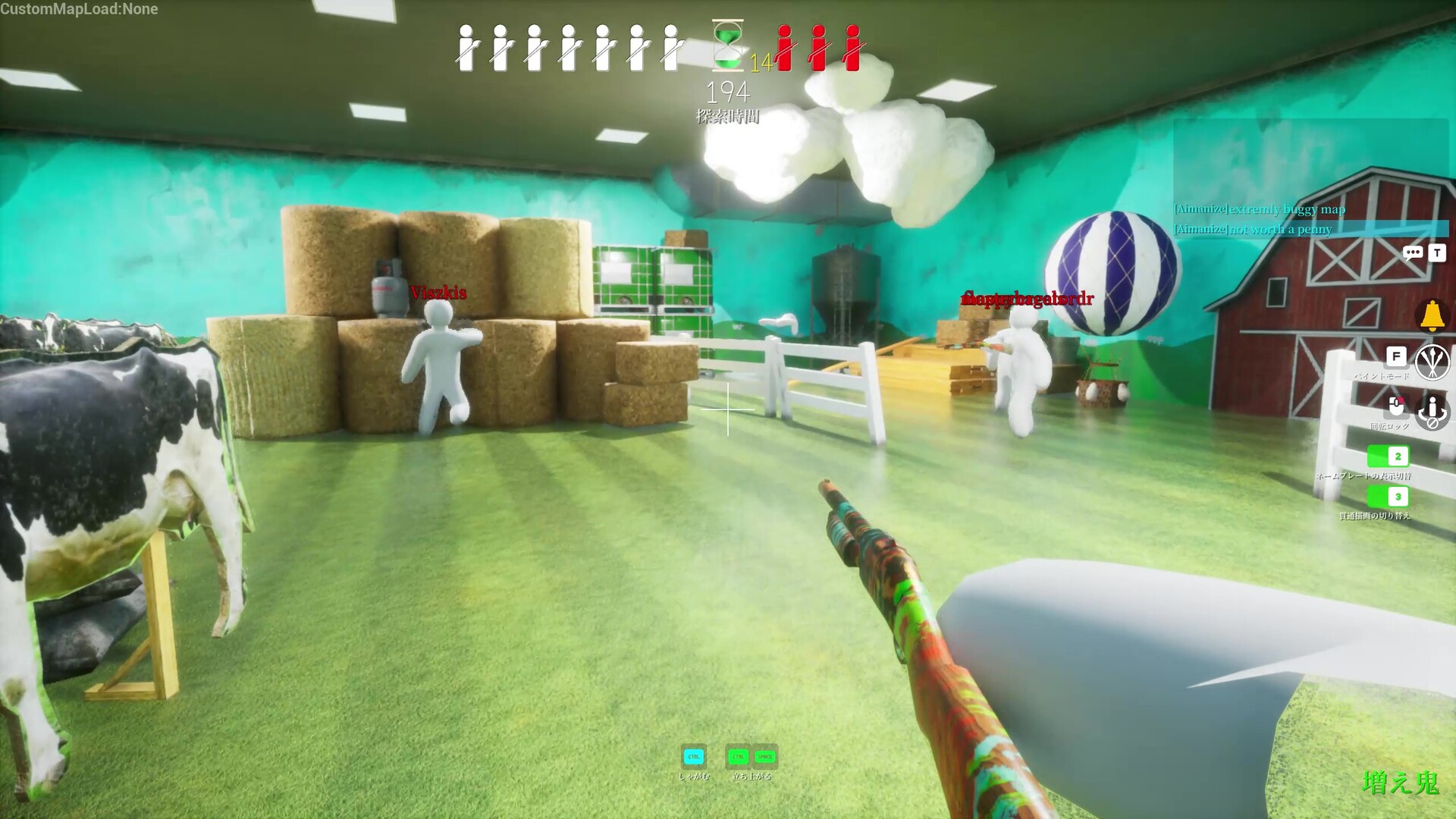
Maps such as candy or stylized outdoor spaces may use saturated colors. Do not assume natural colors. Sample the actual surface.
Community color-code examples
One community guide claims measured surface values for several maps. Examples include:
- Hide-and-Seek Mansion green damask wallpaper:
2c3611 - Sewer warm brick walls:
3e2911 - Backrooms wall yellow:
b6b35c/a89b45 - Penguin Hotel royal blue wallpaper:
2b4660/264551 - Sugar Land candy grass:
29bc45/00e003 - Osaka red corrugated buildings:
7b1f2e
Use these as starting points, not absolute truth. Lighting, camera angle, post-processing, and game updates can shift the perceived color.
One-round map lab
Use one match to learn a map instead of chasing a perfect hiding spot. The goal is to leave with a reusable surface rule.
For a focused post-match correction, use Why was I spotted?. Check MECCHA CHAMELEON Updates before relying on an old route after a map rework or randomization change.
Workshop maps
The Steam Workshop supports user-created maps. Observed Workshop examples include maps themed around 2Fort, Minecraft Village, museums, supermarkets, police stations, and other spaces.
For Workshop maps:
- Check whether the host requires a custom map download.
- Read the Workshop item page before subscribing.
- Prefer updated items with comments and visible author activity.
- Expect public lobbies to fail or delay if map downloads do not complete correctly.
What not to trust yet
Until verified by gameplay or official docs, this site should not claim:
- Exact spawn points.
- Best hiding spots for every map.
- Exact round timers for each map.
- Full official base map count.
- That a community color table is always correct after patches.
Sources
- Steam News
- Steam Workshop
- Steam Community Guide:
Exact color codes for every surface — all 7 base maps